Harvey Nichols Restaurant, Forth Floor Edinburgh, Scottish Store, Scotland
Harvey Nichols, Edinburgh : Architecture
Restaurant + Brasserie + Bar, St Andrew’s Square, New Town
post updated 29 April 2025
The Forth Floor Restaurant
Designers: Lifschutz Davidson Architects, London, UK
Forth Floor Edinburgh Reservations:
Telephone bookings number: 0131 524 8350
Harvey Nichols Restaurant – Summary
Harvey Nichols Edinburgh Store
The new restaurant, brasserie and food market on the top floor of this prestigious new department store on St. Andrews Square officially opens on September 4th 2002. This is the third restaurant to be designed by Lifschutz Davidson, following the success of Oxo Tower Wharf on London’s South Bank and Prism in the City of London.
The new 175-cover restaurant and brasserie includes a floor to ceiling low-reflective glass wall and extends out onto a full-length terrace, with spectacular views over Edinburgh Castle and The Firth of Forth. The ceiling is composed of a series of 150 (1.2m diameter) cylindrical coffers with concealed, coloured light fittings that sequentially alter to create a different character for the space according to the time of day. During daytime the space is cool, white and spacious; at night it is theatrical but intimate.
Emphasising Harvey Nichols unique approach to food retailing, the special soffit visually unites all operations on the fourth floor in which the dining areas and food store are separated only by a low glass screen.
Most of the furniture and fittings in the dining areas and Foodmarket are specially-designed and these complement the space and extend the quality of food display and presentation.
Harvey Nichols Edinburgh Site
The new Harvey Nichols department store is at the heart of Edinburgh’s New Town district on the east side of St Andrew’s square. The views from the top (fourth) floor restaurant in the new building are spectacular with a panorama stretching from Edinburgh Castle to the left (south-west) to the Firth of Forth to the right (north-west). The location is as special as that of the 8th floor restaurant at Oxo Tower Wharf on London’s South Bank; in both cases diners have the very best views of the city.
Harvey Nichols Edinburgh Accommodation
The 85-cover restaurant, 90-cover brasserie and bar look out over a full width terrace for outdoor dining when the weather permits.
The separation between the dining areas is flexible allowing the space to be set up for different types of functions.
The fourth floor also accommodates a 6000 sq ft Foodmarket selling everything from fresh produce, groceries and Harvey Nichols own-brand products. Fine wines are available in the Wine Shop and, exclusive to Edinburgh, top of the range utensils in the Kitchen Shop.
During the day the entire fourth floor is generally accessible by escalator from the main department store below. In the evening the Foodmarket is closed and the restaurant, brasserie and bar are separately accessible by lifts.
The design team had to work within the limitations of the external envelope and steel roof structure that had been determined before design work started on the fit out of the top floor.
Forth Floor Restaurant and Foodmarket Layout
The restaurant is located adjacent to the terrace where it can enjoy the best views with the brasserie situated just behind. The bar, which serves both dining spaces, is at the centre of the plan from where it also has commanding views across the city. Movable glass screens between the restaurant and brasserie permit the spaces to be linked or separated depending upon demand.
The Foodmarket is located to the rear of the dining spaces and occupies the centre of the plan, set around the atrium. The food retailing and dining spaces are visually linked and separated by glazed screens. The Foodmarket is an open plan space with purpose designed racking and display counters for wine, fresh produce and delicatessen.
During the day customers rise up through the building on escalators that terminate at the main food produce counter on the top floor. They then circulate past the food displays to the restaurant reception desk located on the front right-hand side (north-west) of the building.
The kitchens, backup spaces and toilets are discreetly located to either side of the main space serving the dining spaces and Foodmarket without intruding on the views.
At night, when the Foodmarket is closed, patrons use a separate entrance on the north of the building and travel by dedicated lifts to the fourth floor, emerging in the reception area.
Harvey Nichols Edinburgh Ceiling
The ceiling is designed to tie together the very different spaces and functions of the fourth floor into a coherent food retailing and eating experience, clearly identifying the position of the main access escalators and the view to the west.
Oxo Tower restaurant in London, also designed by Lifschutz Davidson, demonstrated the benefits of changing the ambience of the restaurant between day and night. There the ceiling is made of white/blue louvers that are positioned during the day to create a light ceiling to enhance the bright buzzy space. After dusk the louvers rotate to create a dark blue soffit and low intensity blue lamped luminaires emphasise the darker nighttime setting and permit unfettered views through the 5m high glass wall.
Just as in the London restaurant, the Forth floor serves food from 10am until late in the evening and the restaurant ceiling is designed to create a range of different scenarios that respond to the time of day and reduce the risk of reflections impeding the magnificent night-time views.
Over 150 coffers are set into the soffit; most are cylindrical shapes of 1.2m diameter and each of these is provided with a concealed red and yellow cold cathode light fitting. During the daytime the white-painted, GRG (glass reinforced gypsum), coffers enhance the large area of visible ceiling. At night they glow illuminating the space with ambient light varying from a bright orange at twilight to a low red glow later on.
Six larger, linear coffers are located over the escalators in the central atrium. Above these is a skylight that punches daylight into the heart of the building; at night these are illuminated with blue light creating a counterpoint to the colour settings in the other ceiling coffers.
The lighting is treated as an intimate part of the design rather than an add-on. Hence, the special ceiling which works equally well in daytime when the artificial lights are off with the coffers providing interest and relief to the large soffit, or at night when they create a distinctive setting for the restaurant which becomes visible from far away.
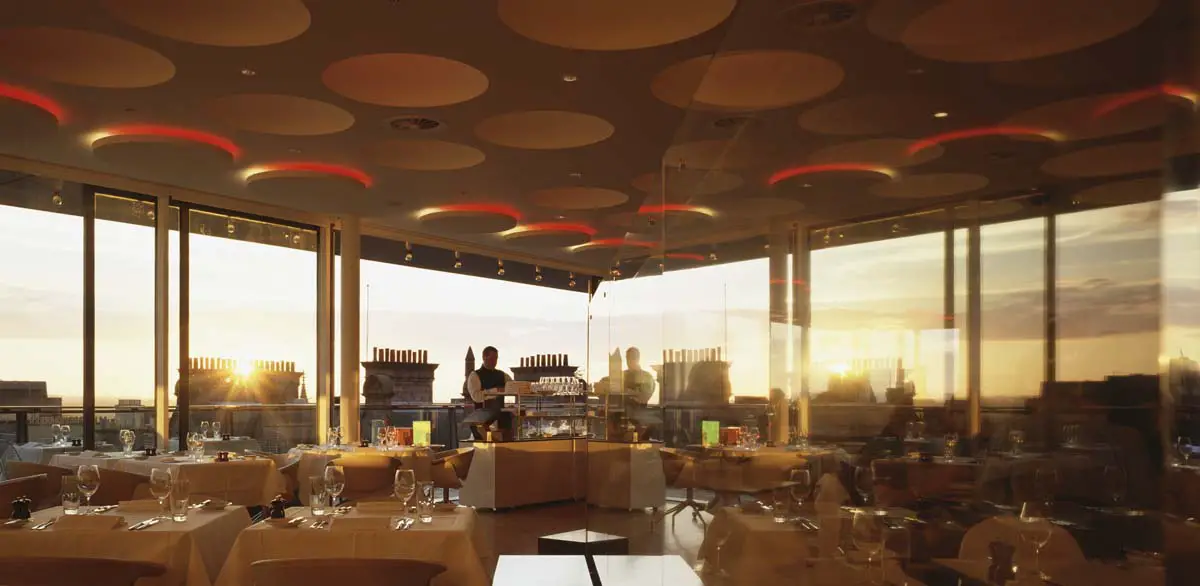
Forth Floor restaurant evening view looking north-west supplied by Harvey Nichols PR agency
Harvey Nichols Edinburgh – Materials
Materials were chosen for their intrinsic quality, durability and function. The warmth and texture of the surfaces are tuned to their location and use; thus timber in the more intimate restaurant, bar and reception desks with stone and stainless steel for the more highly-utilised Foodmarket and display units.
The external wall glazing is a special coated glass called Amiran by Schott Glass, specially formulated to give minimal reflection. This, combined with the lighting system provides patrons inside with unobstructed views out and city folk with clear views into the space.
The ceiling is made of plaster and glass reinforced gypsum coffers painted white; walls too are painted white and the total effect is calculated to create a bright white enclosure to the space during the day and a suitable background for the special lighting effects in the evening.
The retail area floor is covered in white Carrara marble, with finger block European oak parquet used to give warmth and texture to the restaurant and brasserie. The toilets are floored in large Nero India black granite tiles chosen to set off the delicate glass tiles, white sanitary ware and stainless steel ironmongery and details.
Special Furniture & Fittings
Most of the interior fittings and furniture in The Forth Floor Restaurant, Bar & Brasserie were purpose designed for the project. All fixed furniture and much of the specialist restaurant furniture was specially created including:
Reception desks
Bar
Waiter stations
Menu holders
Wine coolers
Service trolleys
Moving glass screens
Food produce counter
Delicatessen counter
Back illuminated wine display racking
Retail checkout counters
Toilet sinks
Purpose designed food display furniture is made of low iron glass and stainless steel with white laminate. The bar and reception desk are fronted by teak timber profiles to add texture and warmth; the bar is topped by Carrara Sivec marble.
Restaurant tables, chairs and demountable shelving in the Foodmarket were purchased items. The restaurant chairs are Sina by B+B Italia, which are white laminate on brushed stainless steel bases with cream leather bucket upholstery. The brasserie has Eames wire chairs with cream bikini pads.
Harvey Nichols Edinburgh Toilets
The toilets are floored in black granite which sets off the glass tiled vanity units; set within these are stainless steel and mirrored recesses which provide accents to the purpose designed white Corian sinks. Toilet doors are teak timber veneer.
Harvey Nichols Edinburgh Consultant Team + Credits
Architects Lifschutz Davidson
Lighting Design Equation Lighting Design
Service Engineers Arup
Fire Strategy Jeremy Gardner Associates
Cost Consultants E C Harris
Kitchen Design Hansens
30-34 St Andrew Square, Edinburgh, EH2 2AD
The architect for the base building, including the external envelope and roofing, terrace glazing, soffit and balustrade was Comprehensive Design.
Harvey Nichols Restaurant – Scottish Store Building : PR 28 Aug 02
Harvey Nichols Restaurant was one of eight RIBA Award-winning buildings in Scotland in 2003.
Buildings / photos for the Harvey Nichols Edinburgh Architecture page welcome