National Library of Scotland Edinburgh Photos, Architect, Location, Date, NLS building reclad, Leaks, Images
National Library of Scotland
Causewayside Building, Edinburgh design by Andrew Merrylees Associates
26 Feb 2014
National Library of Scotland News
Design: Andrew Merrylees Associates / Hypostyle Architects
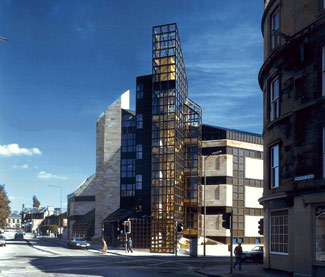
Causewayside building image from Hypostyle Architects
National Library of Scotland Building
The National Library of Scotland has appointed Graham Construction to undertake a £10m reclad and redevelopment of its Causewayside Building, reports Urban Realm today.
The 19,000sqm building, delivered in two phases in 1989 and 1995, has been hit by ‘widespread’ air and water leakage and now requires a replacement roof, rain screen cladding, glazing, stonework and water discharge systems.
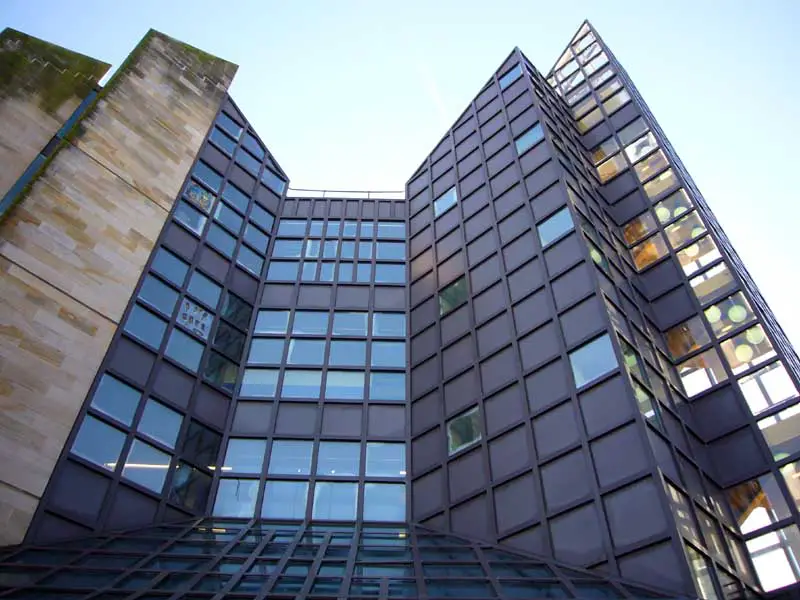
Though not listed Andrew Merrylees Associates (later merged with Hypostyle) won the Royal Scottish Academy‘s 1982 gold medal for architecture with their design. Graham Construction expects to move on site this June for completion in 2017.
National Library of Scotland Edinburgh
Address: Causewayside
Dates built: 1988 ; 1994
Design: Hypostyle Architects
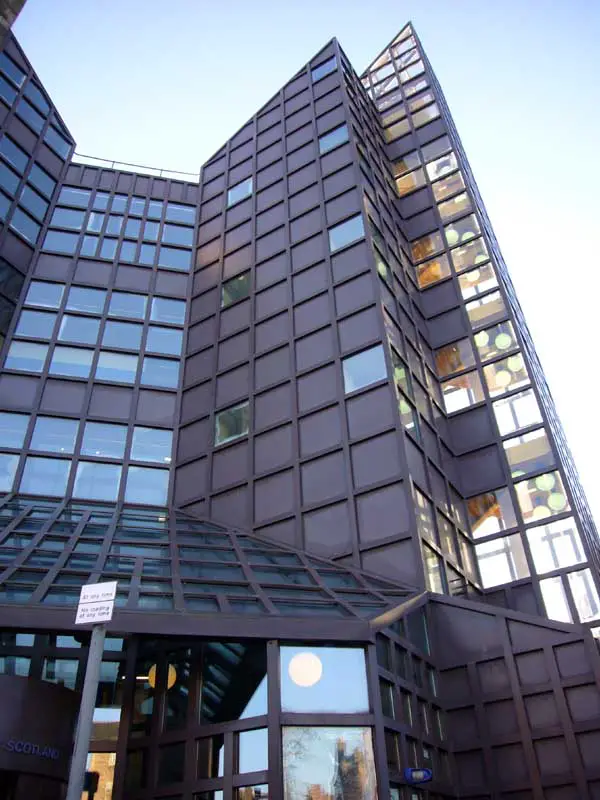
photo © Adrian Welch, 120108
Address: 159 Causewayside, Edinburgh, EH9 1PH, Scotland
Phone: 0131 623 3970
The National Library of Scotland (NLS) is the successor to the Library of the Faculty of Advocates, which opened in 1689. The Faculty presented its collection to the nation in 1925 and NLS was formally constituted by Act of Parliament. The Library has been a copyright library since 1710, with the right to claim a copy of every work published in GB.
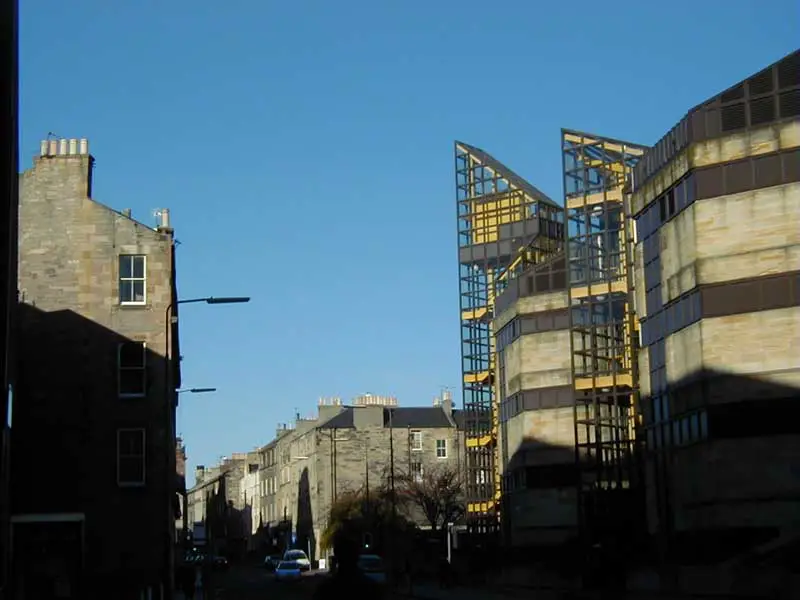
Causewayside building image from Hypostyle Architects
National Library of Scotland (NLS) – Description
Given that it is the function of a copyright library to collect an ever-increasing range of publications, and to preserve them for the future, it follows that much of the NLS’s history has been inextricably tied up with the provision of additional space.
With the main library building at George IV Bridge filling up the site at Causewayside, about one mile south of George IV Bridge, was chosen for expansion. It was necessary that the new library building would have to be developed in two phases, because NLS already occupied part of the site for their Map Room and out-housed stock.
Design work on National Library of Scotland Phase 1 began in 1980 and construction of Phase 1 (£10.5m) started in 1984 and it opened to the public in August 1988. Detailed planning of Phase 2 (£14m) then commenced and was completed in 1994.

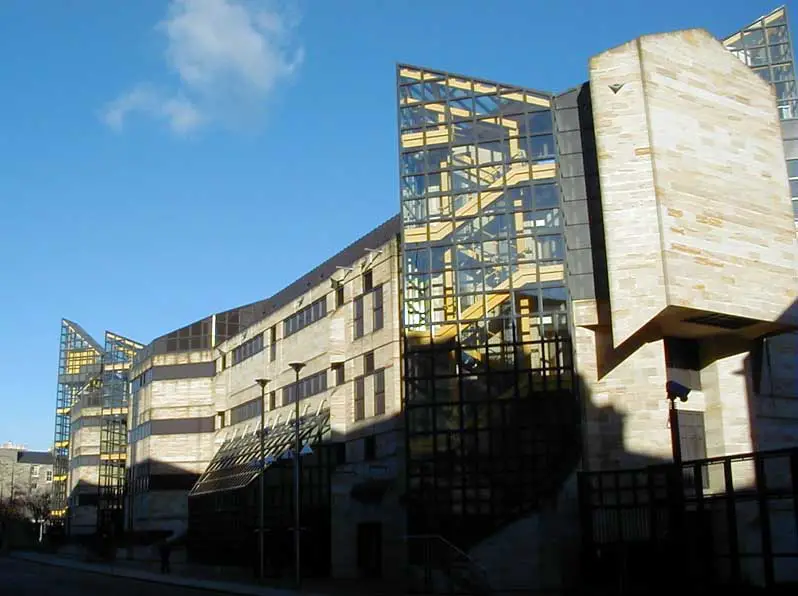
National Library of Scotland: Causewayside building – images from Hypostyle Architects
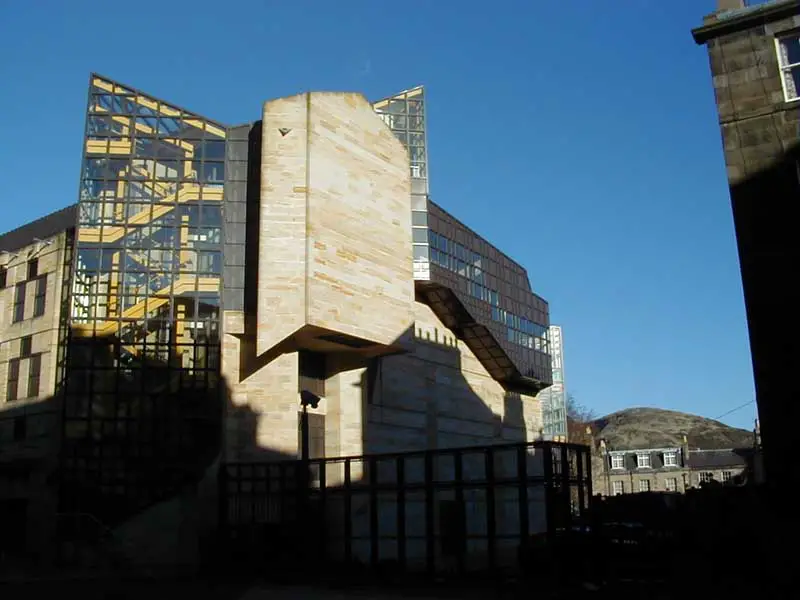
The outside of the National Library of Scotland building reflects its interior functions. The vertical services, lifts and staircases are placed around the perimeter leaving the interior as uninterrupted as possible. This allows the installation of large blocks of ‘mobile’ bookstacks at the lower levels, so permitting the most cost effective use of space. All floors are capable of accommodating bookstack throughout as the NLS collection expands.
Around the perimeter run horizontal service corridors carrying electrical cabling, plumbing, and air-conditioning equipment. Additional services can be brought in from these corridors to permit flexible change of use in internal spaces. To carry the great weight of books imposed by the mobile bookstacks, the National Library of Scotland building has a high load-bearing capacity.
Since the book stackage demands a very small tolerance in the level of its support rails, a shallow secondary floor system was developed to sit on top of the main structural floor. The steel rails supporting the stacks have adjustable jacks to level rails if necessary.
The space thus created below the suspended floor is used to extract the conditioned air (which is delivered by ducting at ceiling level) into the perimeter corridors, and to provide services at any point on the floors, using outlet boxes set into moveable suspended floor tiles.

National Library of Scotland: Causewayside building – image from Hypostyle Architects
The NLS building was designed around the individual bookshelf length of 900mm. Floor panels, window panes, counter lengths, and internal partitions are based on this module. The National Library of Scotland floor slab is in the form of a coffered slab on the 900mm module, in exposed reinforced concrete of a very high-quality finish, coloured light buff to harmonize with the stonework.
The NLS wall and lift towers are clad in sandstone from Newbigging Quarry near Burntisland in Fife, which was especially re-opened in 1984 for this building.
Apart from the staff areas on the library top floor (Level 7), the only windows are on the north façade. All National Library of Scotland glass incorporates UV filtration and the 900mmplaning module is picked up in the fenestration and roof detailing. Specially commissioned works of art by 12 contemporary Scottish artists are laminated in the windows.
The National Library of Scotland building is sunk two-and-a-half floors below ground, thereby reducing its apparent size and impact on its immediate environment. The cross-section is stepped down from the high canyon of Causewayside on the west, to the low domestic scale of Upper Gray Street on the east.
NLS Building information from Hypostyle Architects 2003
Edinburgh Library Buildings
NLS Architects
Andrew Merrylees Associates who became Andrew Merrylees Grierson + Robertson in 1994, becoming Merrylees + Robertson in November 1997 and merging with Hypostyle Architects in Jan 2001.
Lothian Buildings by Hypostyle Architects
Also by Andrew Merrylees Associates (now Hypostyle Architects): Heriot-Watt University
Heriot Watt Student Residences
Scottish Capital Building Designs
Scottish Capital Property Designs – recent architectural selection below:
image courtesy of architects practice
1 Broughton Market short term let apartments
Design: John Robertson Architects (JRA)
British Medical Association HQ Edinburgh
West Town Edinburgh 20-minute neighbourhood
Comments / photos for the National Library of Scotland Building design by Andrew Merrylees Associates (later merged with Hypostyle Architects), United Kingdom, page welcome.