Rosslyn Chapel, Scottish historic building photos, Location, Architecture history, Collection
Rosslyn Chapel Edinburgh
Roslin Church, south of Edinburgh, Midlothian, Scotland – featured in Dan Brown’s The Da Vinci Code.
post updated 27 April 2025
Papers relating to Rosslyn Chapel available to the public for the first time.
A newly acquired collection relating to Rosslyn Chapel helps to shed light on the remarkable architecture and restoration of one of Scotland’s most outstanding buildings.
Rosslyn Chapel collection:
photograph © Neil Hanna
28 March 2022
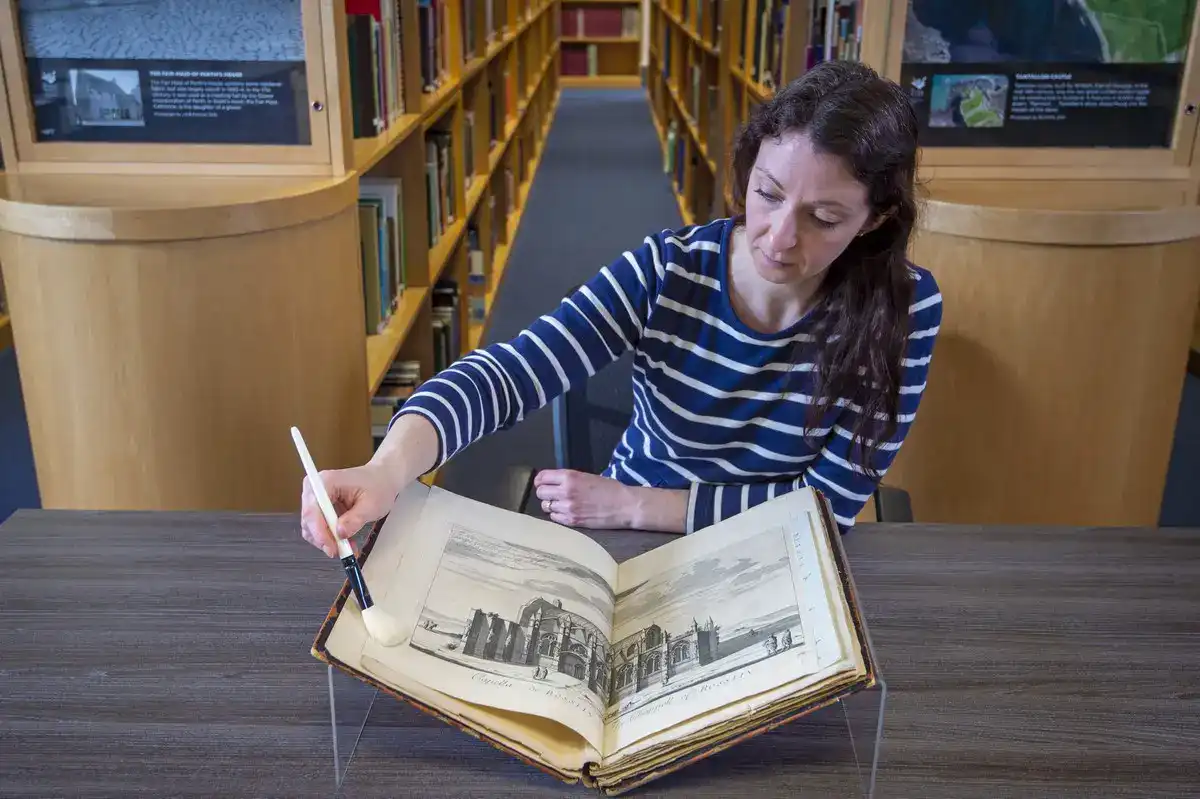
Rosslyn Chapel Papers
An important collection recently acquired by Historic Environment Scotland (HES) will provide the public with the opportunity to find out further secrets of the world-famous Rosslyn Chapel, which has long been an inspiration for artists and writers including John Ruskin, William Wordsworth, Sir Walter Scott and most recently Dan Brown’s The Da Vinci Code.
The collection of drawings, manuscripts and engravings assembled by prominent architectural publisher and antiquarian John Britton (1771-1857), reveals contemporary thoughts from the likes of architects William Burn and George Meikle Kemp about the restoration and history of the chapel.
Countess of Rosslyn & Ian Gardner from the Rosslyn Chapel Trust:
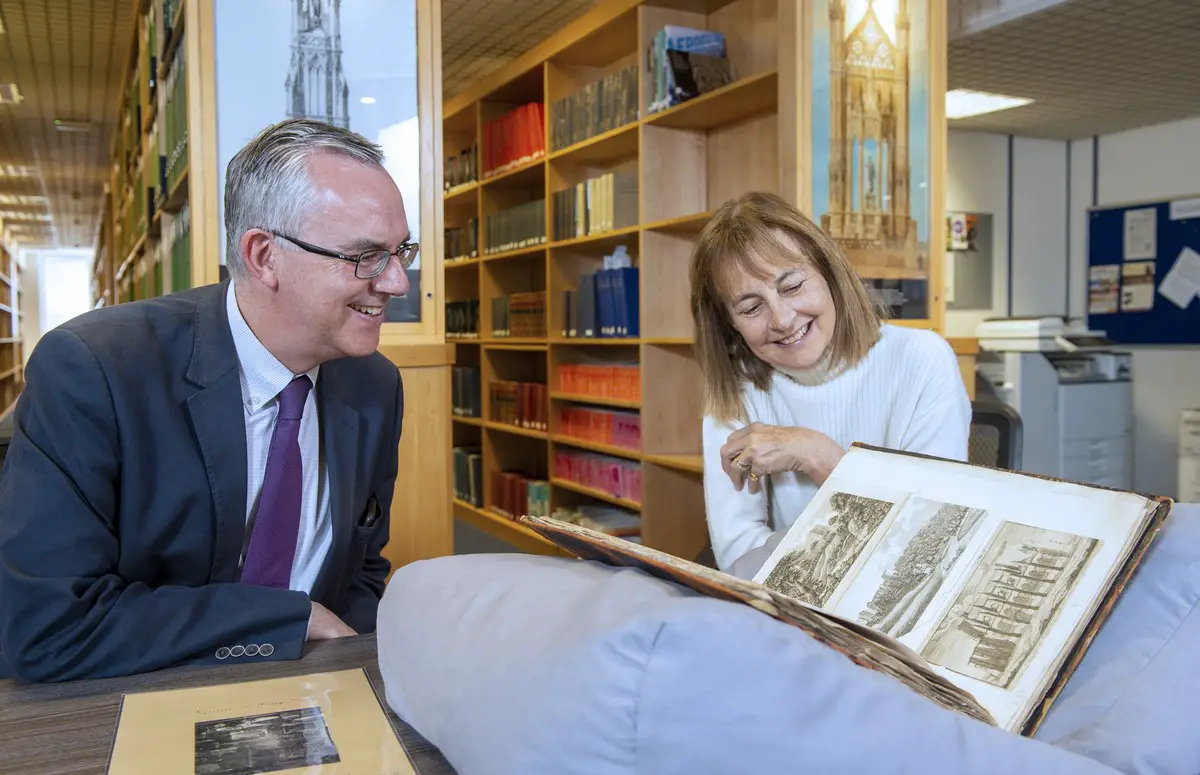
photo © Neil Hanna
Rosslyn Chapel, established in 1446, is renowned for its Gothic architecture and the wealth of intricate carvings that make up its beautiful interior, which have long given rise to speculation of its association to the Knights Templar and the Holy Grail. To this day there are legends of a hidden underground crypt also discussed in the papers within this new collection.
By the 19th Century the chapel had fallen into picturesque disrepair; after succeeding as 3rd Earl of Rosslyn in 1837 James Alexander St Clair-Erskine, ordered external repairs, overseen by Edinburgh architect William Burn, with the restoration of the interior beginning in 1861 under architect David Bryce. Queen Victoria, after a visit in 1842, expressed her admiration for the chapel and her support for its preservation.
This restoration to the magnificent medieval chapel became the source of disagreement and debate, revealed in HES’s newly acquired collection, which includes evidence of correspondence between artist David Roberts and John Britton on the restoration and history of Rosslyn Chapel.
Countess of Rosslyn & Ian Gardner from the Rosslyn Chapel Trust:
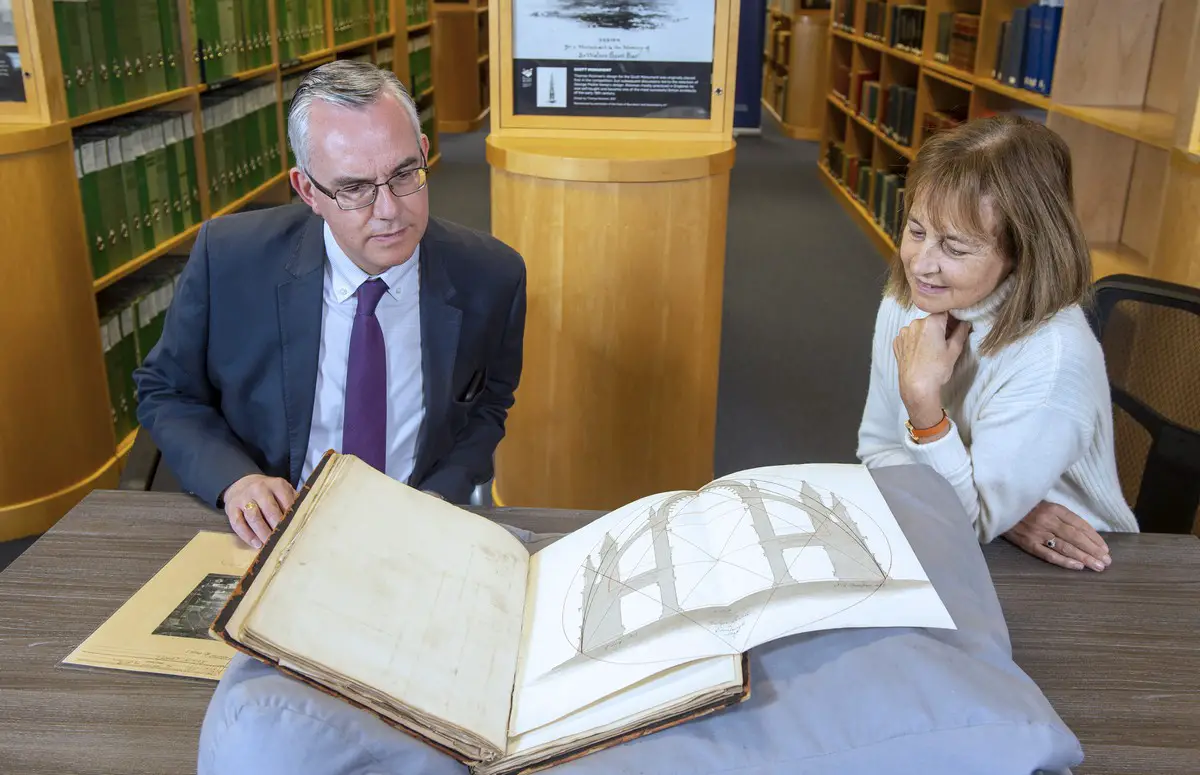
photo © Neil Hanna
The papers also contain the views of Britton’s circle of correspondents including George Meikle Kemp, architect of the Scott Monument, and Sir Walter Scott himself, highlighting how passionately architects and artists alike felt about the building, and the regard in which Rosslyn Chapel was held.
The collection will be available for visitors to view by appointment in the Search Room of the HES Archives. HES then plan to carefully conserve and catalogue the collection, with the digitisation process taking place during 2022-23, to create a digital copy that will be available to a wider audience using the online catalogue Canmore.
The acquisition of this album was made possible with a grant from Friends of the National Libraries and the support and advice of the Rosslyn Chapel Trust.
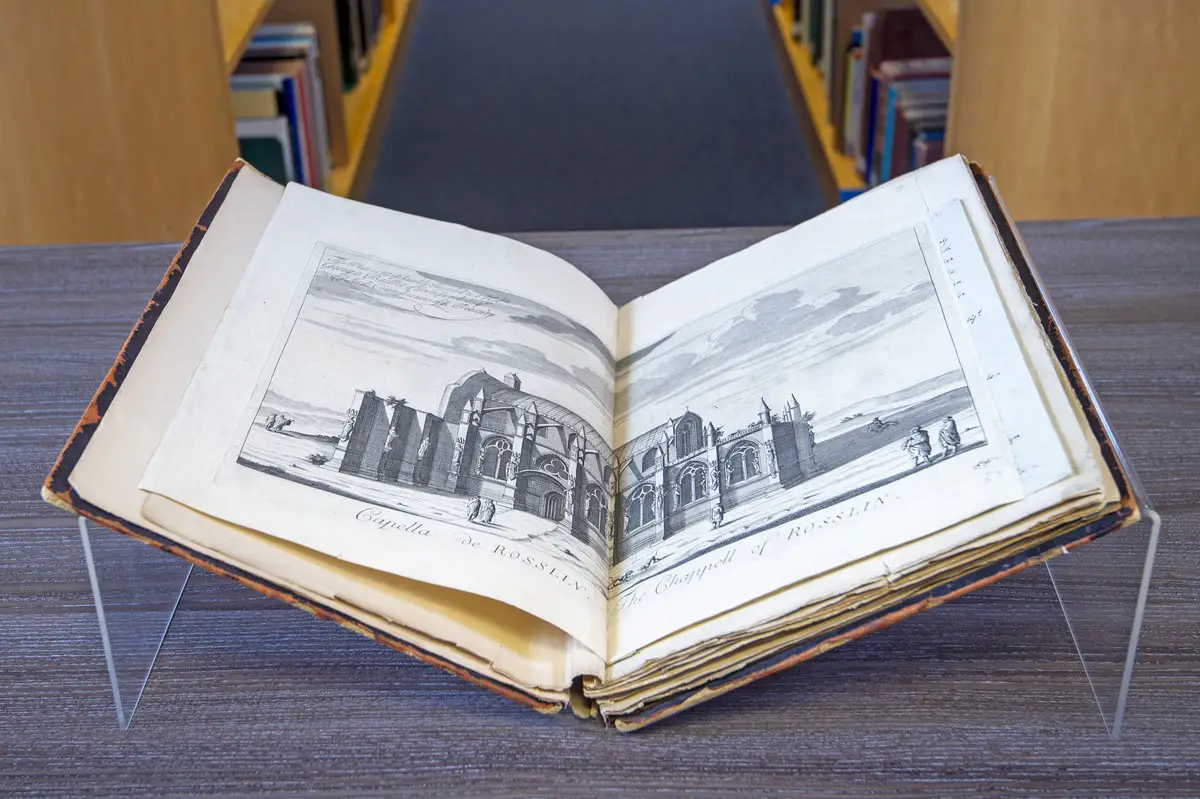
photo © Neil Hanna
Veronica Fraser, Acquisitions and Loans Manager at HES said:
“This collection holds particular importance as it relates to one of Scotland’s most renowned and architecturally fascinating historic buildings and demonstrates how it invoked so much inspiration and strength of feeling in the past and continues to intrigue people from around the world to this day.
“HES are delighted to be able to make this wealth of information available to researchers and members of the public and we are grateful to the generosity of the Friends of the National Libraries and the support of the Rosslyn Chapel Trust to bring this material into our archives and provide people with the opportunity to find out more about this exciting chapter in the Chapel’s story.”
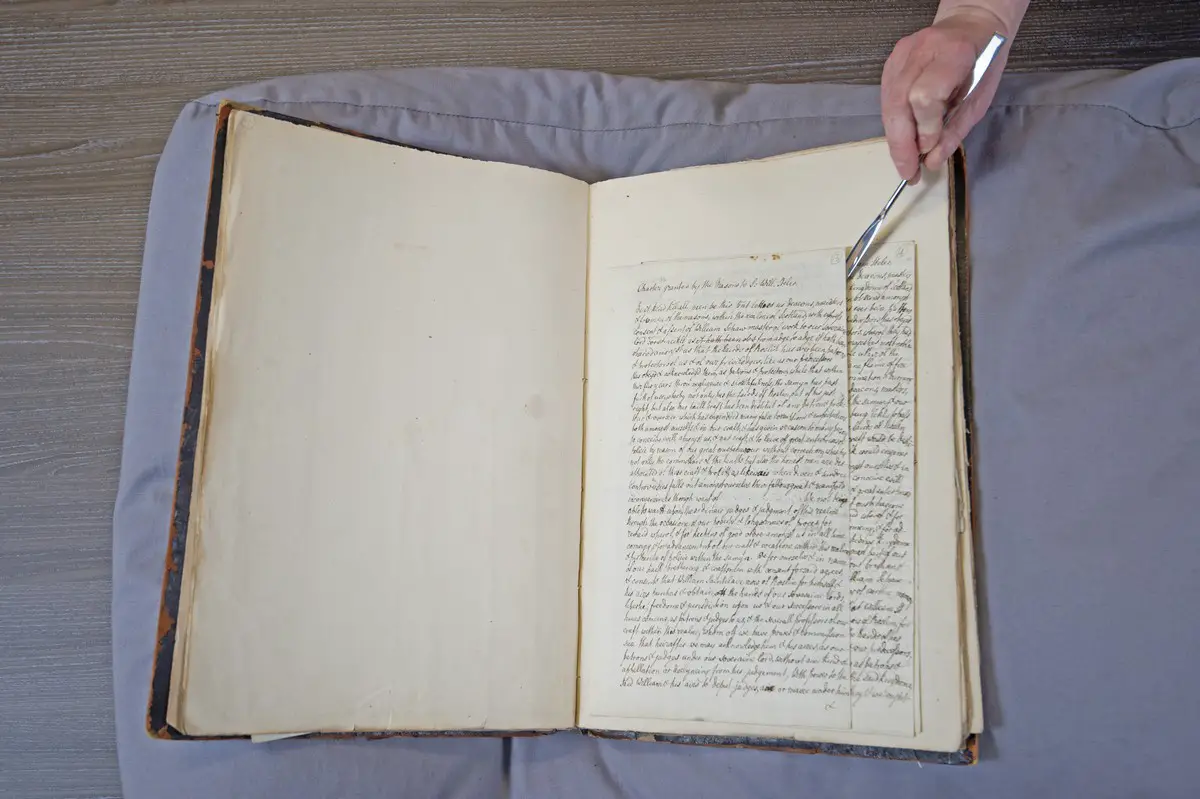
photo © Neil Hanna
Ian Gardner, Director of Rosslyn Chapel Trust, said:
“It’s wonderful that this important collection of papers relating to Rosslyn Chapel is now in the safe care of Historic Environment Scotland and will be available for public consultation.
“Since it was founded in 1446, the Chapel has attracted, intrigued and inspired debate amongst artists, writers and visitors, as clearly shown in this collection, and it continues to do so today.”
Previously on Edinburgh Architecture:
Rosslyn Chapel
Rosslyn Chapel Trust – Roslin – building design by Simpson & Brown, Roslyn Glen, Edinburgh, Midlothian, Scotland
Museum on Knights Templar & Freemasonry also designed by Simpson & Brown Architects, Edinburgh
Roslin Church, Roslin, south of Edinburgh, Midlothian
just south-east of Roslin village, off B7006, by Roslin Glen.
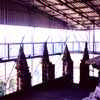
roof photo © Adrian Welch
The foundation stone for Rosslyn Chapel was laid on St. Matthews day, 1446. The orientation is due east & west, marked out by the solar ray by ancient tradition. A double equilateral triangle regulates the proportions at Rosslyn.
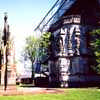
west facade picture © Adrian Welch
Foundations for a much larger nave at Rosslyn Chapel excavated in the 19th century suggest grander plans were made for the church. The chapel as seen now is therefore what would have been the choir as the larger nave was never built. Rosslyn Chapels’ asymmetry is just one of the many unique architectural features.
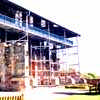
south facade photograph © Adrian Welch
There are 32 different forms of arch throughout Rosslyn Chapel and a large variety of allegorical pillar treatments.
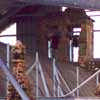
roof image © Adrian Welch
Rosslyn’s famous ‘Apprentice Pillar’ (or Prentice Pillar / Princes Pillar) was apparently the result of a bizarre series of events: the master mason who commenced carving the Apprentice Pillar was unable to complete the work. He went to Rome to receive guidance on finishing it. On returning to Rosslyn the mason discovered the pillar had been completed by his apprentice. The master mason subsequently killed his young apprentice in anger.
Image from the Castle in Roslin Glen, looking North East:
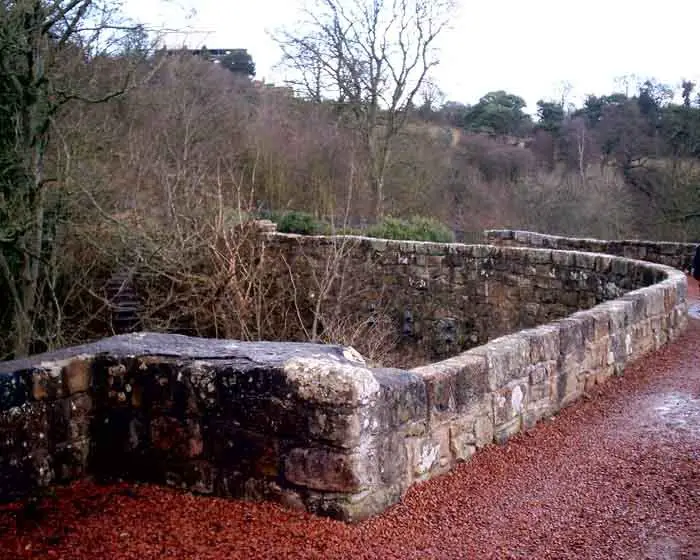
image © Adrian Welch
On the three pillars standing between Rosslyn Chapel’s east aisle and the east chapel is a choir of thirteen angels with musical instruments, representing the host of God. On some of the other pillars are a series of carvings showing Issac on the alter with the ram caught by the horns, Abraham looking towards his son, Samson destroying the philistine lords, David killing the lion, the Prodigal son, the Crucifixion and a some that depict the history of the Roslin Family. Also of interest are the masons marks on the individual stones, the use of which, was rare even at the time of building.
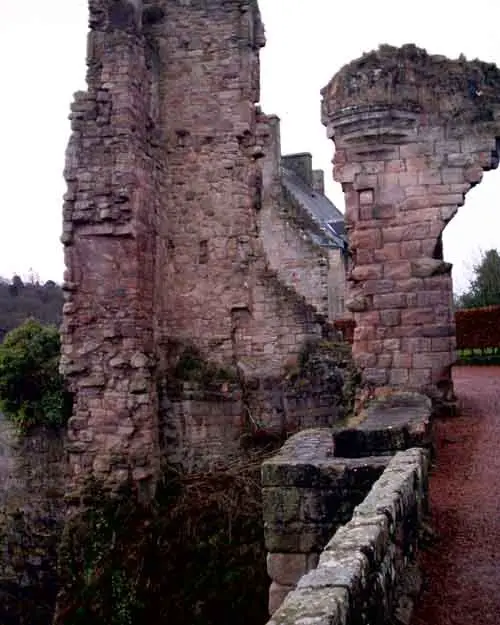
Rosslyn Castle image © Adrian Welch
The central pendant at the east end of Rosslyn Chapel has a representation of the Star of Bethlehem and sculpted figures of the Virgin and Child and Eastern Kings associated with the birth of Christ. On the ribs of Rosslyn’s groins (intersections) on the north and south sides are representations of various occupations in life which is also referred to as the ‘Dance of Death’.
Rosslyn Chapel architects for Phase Two – Simpson & Brown.
Rosslyn Castle
The Rosslyn Castle is located just 5 minutes to the south-west of the Chapel:
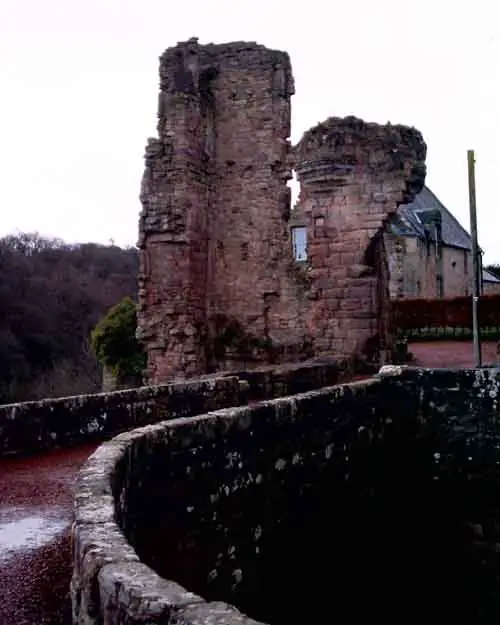
Rosslyn Castle image © Adrian Welch
Rosslyn Chapel: Opening Times
(correct at time of writing) – check with owners:-
Mon – Sat 10am to 5pm
Sun 12pm to 4.45pm
: Phase 2
Simpson & Brown Architects
Valued at £395k, church refurbishment funded by The Heritage Lottery Fund, The Eastern Scotland European Partnership, Historic Scotland and the Rosslyn Chapel Trust
Rosslyn Chapel Restoration : News Update 2007
The Heritage Lottery Fund and Historic Scotland announce the results of Rosslyn Chapel Trust’s multi-million pound bid to restore and conserve Scotland’s most captivating enigma.
Date: 22 Mar 2007 Venue: Rosslyn Chapel, Roslin, Midlothian
Press conference at which Patricia Ferguson MSP, Minister for Tourism, Culture and Sport, and Brian Lang, Chairman of the Heritage Lottery Fund’s Scotland Committee will announce whether the chapel is to be restored and its visitor facilities extended with a multi-million pound grants from the Heritage Lottery Fund and Historic Scotland.
Rosslyn Chapel – Collegiate Church of St Matthew, south side of the village of Roslin, south Edinburgh, Scotland.
various skilled craftsmen, no named architect/head mason 1446
world-famous 15th century chapel
Rosslyn Chapel Functions
Rosslyn Chapel is used as a church but includes a Museum and is a focus for both tourists and people interested in the Freemasons, Knights Templar, the St Clair/Sinclair clan and various mythologies. Just to the south of Rosslyn Chapel can be found a wonderful castle jutting into the river gorge. Walk along the lane (near car park) until you reach an old stone bridge high above the Esk valley: the private Rosslyn Castle will stand before you. A few miles further south of Rosslyn Chapel lies Temple, a village again with an interesting old church, the former site of Balantrodoch, the Templars’ headquarters in Scotland.
Mythology + Mysticism at Rosslyn Chapel
The most visible mysticism at Rosslyn lies in the unusual carvings and inscriptions – more re this under ‘Decoration & Sculpture at Rosslyn Chapel’. Dowsers and diviners recognise Rosslyn Chapel as a place of power. The Chapel lies at the conjunction of two major ley lines. Within Rosslyn’s grounds and inside the chapel, master dowsers have reported major movement. One sign of this energy reportedly appeared one night on Rosslyn Church’s altar stone.
Some reports suggest Rosslyn Chapel was designed to hide something of great importance – the twelve Disciples, Jesus, the Holy Grail, early gospels, the Ark of the Covenant, the Stone of Destiny, the mummified head of Christ, various types of treasure or sacred objects. The guides at Rosslyn will advise that soldiers are buried under the church nave in full armour. Intiguingly the vaults were sealed in the 17th century.
Treasure worth ‘several million pounds’ is reputedly buried beneath Rosslyn Castle vaults, and is said to be guarded by one of the St Clair ladies. If awakened, she is supposed to point to the place where the treasure is buried, and when this happens Rosslyn Castle will rise from its ruins.
In 1930 Dr Karl Hans Fuchs, a former member of the Thule Society – the occult/mystical group – came to Rosslyn Chapel. While visiting the Edinburgh Theosophical Society, Fuchs advised that he had been ‘sent’ to Scotland.
The treasure under Rosslyn Castle – mentioned above – is believed to be (by some) the treasure of the Templars that Philip IV of France failed to seize when he suppressed the Order in 1307. Rosslyn Chapel is seen by many as the ‘missing link’ that demonstrates continuity between the Knights Templars and the Freemasons.
Rosslyn Chapel & The Knights Templar
The Knights Templar were a brotherhood of noblemen formed in the 11th to 12th century under the protection of the Pope and were connected closely with the Crusades. Rosslyn Chapel is reputed to have been the gathering place for the Scottish Crusaders on their way to Palestine. Sir William St Clair’s grandfather had strong links with the Knights Templar, and intriguingly Columbus sailed under the Templar flag.
Templars, named after Jerusalem’s Temple of Solomon, started in 1098 allegedly to protect pilgrims travelling to the Holy Land; ‘families’ forming this Order were the instigators of the original formation of the Crusades in 1095. The ‘Rex Deus’ families possibly used this as an opportunity to regain their ‘inheritance’ that their forbears had concealed in vaults under the Temple of Solomon prior to their sacking by the Romans around AD70.
Many claim that the Templars true purpose was to excavate the foundations of the Temple of Jerusalem to look for certain ‘treasures and knowledge’. The Knights Templars soon became incredibly rich and powerful, fuelling suspicion that they must have found something, Speculation that the Templar’s ‘treasure’ lies in the sealed vault under Rosslyn Chapel is supported by the church floor plan being an exact scale replica of Herod’s Temple plan.
So powerful did the Knights Templars become that soon they presented a threat to both church and state. In 1307, King Phillippe IV of France – with the blessing of the Pope (who was under his control) – rounded up all known Templars. Accused of blasphemy and heresy, they were tortured and burned at the stake. Not all the Knights Templars died.
Their fleet stationed at La Rochelle escaped – many to the west coast of Scotland, where they were guaranteed safe haven since Robert the Bruce had himself been excommunicated. These warrior monks are reputed to be the cavalry who rode in and turned the Battle of Bannockburn in Bruce’s favour guaranteeing victory and independence for Scotland.
Rosslyn Chapel & The Freemasons
The Freemason connection is explained in Rosslyn’s Museum (above the entry shop). In the 17th century Oliver Cromwell – a Grand Master Mason – refused to allow Rosslyn Chapel to be destroyed. The Sinclairs were enemies (Royalists as opposed to Roundheads), but though Cromwell’s troops destroyed Rosslyn Castle, on his instructions they left the Chapel. In 1962, an Edinburgh schoolmaster claimed that the Holy Grail was hidden in Rosslyn Chapel’s Apprentice Pillar.
He believed it contained a lead casket, containing the legendary cup used by Christ at the Last Supper and later used to collect His blood. The Hiram Key, a book published in 1996, and its sequel The Second Messiah discusses the Apprentice Pillar and the Holy Grail. Its authors said there were credible grounds for suggesting Rosslyn Church was built as a shrine for the holy scrolls.
In 1998 anthropologist Dr Keith Laidler wrote a book in which he claimed that Christ’s mummified head was buried in Rosslyn’s vault; he claimed that an inscription on the Apprentice Pillar reads ‘Here beneath this pillar lies the head of God.’ Knights Templar apparently lie in full battle armour in Rosslyn’s sealed vault below the chapel. Sir Walter Scott wrote in ‘The Lay of the Last Minstrel’ “that chapel proud, where Roslin’s chiefs uncoffined lie”.
Decoration & Sculpture at Rosslyn Chapel
The St. Clairs of Rosslyn (now known generally as Sinclairs) were the family that built Rosslyn Chapel, principally Sir William St Clair, known as ‘Prodigus’, 3rd Prince of Orkney. Like other collegiate churches, Rosslyn Chapel was intended as a place of Christian learning, but Sir William St Clair’s intentions seem unorthodox: Rosslyn appears to never have been intended to be just a Christian church.
Sir William was the grandson of Prince Henry St. Clair of Orkney, known as ‘the Navigator’ (Henry Sinclair of Roslin), who many believe led an expedition to America around a hundred years before Columbus’s ‘discovery’ of the New World in 1492: evidence to support this is seen in the carbon-dating of the ‘American’ corn sculpted at Rosslyn. Various evidence suggest Prince Henry St. Clair crossed the Atlantic in 1398 and landed in an area he named Nova Scotia in honour of his beloved Scotland.
Rosslyn was supposed to be much larger, not a chapel but a church. Only the choir, Lady Chapel and part of the transepts were completed. St Clair intended to construct a huge collegiate church. Construction halted soon after the Sir William’s death in 1484. The vestry added to the facade nearly 400 years later is the sole subsequent addition to this small Medieval edifice (in 1998 Rosslyn Chapel visitor centre opened in a separate building a few yards to the north).
The foundations of Rosslyn’s nave are said to have been excavated in the 19th century and found to extend 91 feet beyond the chapel’s original west door, under the existing Baptistry and churchyard.
Sir William St Clair employed some of the best stonemasons in Europe. The Christian, Pre Christian, Pagan and Arabic symbolism means Rosslyn Chapel for some is the supreme example of medieval architecture in the UK. At the time of writing access can be gained to roof level: amazingly Rosslyn’s roof is made of thick blocks of stone. These walkways are perfect for studying the multitude of decorated pinnacles, gargoyles and flying buttresses. Inside the foliage carving is particularly outstanding, with botanically accurate depictions of over a dozen different leaves and plants.
Among them are cacti and Indian corn (considered unknown in Europe before Columbus’ discovery), providing fairly convincing evidence that the Rosslyn Chapel founder’s grandfather, the daring sea adventurer Prince Henry of Orkney, did indeed, set foot in the New World before Columbus.
Sculpted scenes at Rosslyn include ones from the Bible – the Fall of Man, the Expulsion from the Garden of Eden, the Birth of Christ, the Crucifixion and the Resurrection – which follow each other across walls and ceilings. The rich and subtle figurative sculptures have given Rosslyn the nickname of ‘A Bible in stone’ (also ‘Cathedral in miniature’), though they’re often more allegorical than literal, with portrayals of the Dance of Death, the Seven Acts of Mercy and the Seven Deadly Sins. Rosslyn’s vaulted soffit features hundreds of small stone cubes, intricately carved with mysterious symbols. This is rumoured to be coded musical notation: a prize of £5,000 awaits someone who can break the code.
The greatest and most original carving of all at Rosslyn is the extraordinary knotted Apprentice Pillar (around 2.5m high), symbolising the ‘Tree of Life’, at the south-eastern corner of the Lady Chapel. According to local legend, the pillar was made by an apprentice during the absence of the master mason, who killed him in a fit of jealousy on seeing the finished work.
A tiny head of a man with a slashed forehead, set at the apex of Rosslyn Chapel ceiling at the far northwestern corner of the building, is popularly supposed to represent the apprentice, his murderer the corresponding head at the opposite site. The entwined dragons at the foot – eight winged serpents which have eaten evil’s forbidden fruit – are symbols of Satan, and were probably inspired by Norse mythology.
The spirals which coil around the ‘Tree of Life’ form a double helix, reminiscent of DNA – the basis of life – but intriguingly when the pillar was carved the meaning of the double helix wasn’t to be discovered for another 500 years. Just left of the Altar of the Blessed Virgin, with at the right of the pillar a particularly important carving: Lucifer, the fallen angel, bound and upside down.
Rosslyn Chapel Trust: Archaeology of the Chapel
Rosslyn Chapel Trust – responsible for the chapel’s conservation – has reportedly considered allowing archaeologists the opportunity to probe its sealed vaults. Some of the greatest artefacts in archaeological folklore are said to exist under Rosslyn Chapel. The chapel survived attacks during the Reformation and occupation by Cromwell’s troops a century later. It was damaged in 1688 when a mob ransacked its ‘Popish’ furniture and vestments.
Royal visitors to Rosslyn Chapel include George V and Queen Mary in 1931 along with Prince Albert (later King George VI) and the Princess Elizabeth; Queen Elizabeth II and Prince Philip visited in 1961, Princess Margaret in 1988 and The Prince of Wales in 1998.
Contact Rosslyn Chapel: rosslynch(at)aol.com
Simpson & Brown – Rosslyn Chapel Building architect for Phase 2
News Excerpt re Rosslyn Chapel:
Rosslyn : Phase 2 Underway
Valued at £395k, Church refurbishment funded by The Heritage Lottery Fund, The Eastern Scotland European Partnership, Historic Scotland and the Rosslyn Chapel Trust.
Rosslyn Chapel Exhibition
11 Apr – 7 Jul 2002
National Gallery of Scotland, The Mound, Edinburgh
Rosslyn Architecture Links
Simpson & Brown offices in Leith – St Ninians
Edinburgh Properties
Key New Edinburgh Property – Selection:
New National Centre For Music Edinburgh
Scotland Street Lighting Edinburgh Restoration
Comments / photos for the Rosslyn Chapel Edinburgh Architecture, Scotland, United Kingdom, page welcome.