Royal Mile Edinburgh street photos, Scottish Capital buildings history, Architects pictures
Royal Mile Edinburgh Architecture
Edinburgh’s most famous street in the capital of Scotland, UK public realm design.
post updated 7 May 2025
Rethinking the Royal Mile
RIAS Conference, The Hub, Castlehill (The Royal Mile), Edinburgh 5 Dec 2002
The Royal Incorporation of Architects in Scotland is holding an important Conference: Rethinking the Royal Mile will explore the history of what some call the “world’s finest street”, and examine what the future holds for the ancient thoroughfare.
Speakers include Benedetta Tagliabue from the Scottish parliament architects EMBT / RMJM, RIAS Award for Architecture winner Malcolm Fraser, and Ian Spence from Edinburgh City Council’s planning department.
Four young architects – Andrea Faed, John Thomson, Scott Turpie and Stacey Phillips – will also be presenting their visions for sites along the Royal Mile.
Royal Mile Conference
The Royal Mile conference will be chaired by Richard Emerson, Chief Inspector of Historic Buildings, Historic Scotland.
With the Scottish Parliament building due to open its doors next spring, the Royal Mile’s importance to the political and cultural life of Scotland’s capital city cannot be ignored. Rethinking the Royal Mile is a unique opportunity to have your say on the future of this incredible street.
Royal Mile Edinburgh: Conference Tickets £45RIAS – Royal Mile PR 3 Dec 2002
Royal Mile, Edinburgh – 80’s & 90’s
At the recent RIAS conference Rethinking the Royal Mile I was given the unenviable task of talking on a period of time that many in the audience were extremely familiar with. Some may have designed buildings while others where hugely involved with initiatives. I was keen to point out that to me this period of time was history. In 1980 I was aged seven with no thought given to the problems of the Royal Mile.
As I collated the information for this talk I increasingly became distracted by the title ‘Rethinking the Royal Mile’. It seemed to me that over the twenty years, that I was asked to examine, the street had been one of the successes of the city. The population decline in the Old Town had been reversed; holes in the ground had been filled. A Renewal Trust had been successful in attracting funding for public realm works and had brought a renewed confidence to the area.
Indeed during the last decade we have seen projects on the Royal Mile by architects such as Richard Murphy, Malcolm Fraser, Allan Murray and Ben Tindall which have transformed the area. If the rest of the city could have received developments of this quality then we would all be a great deal happier. I would humbly suggest that the streets in which we must work together to solve the problems include Princes Street, Great Junction Street and Leith Walk.
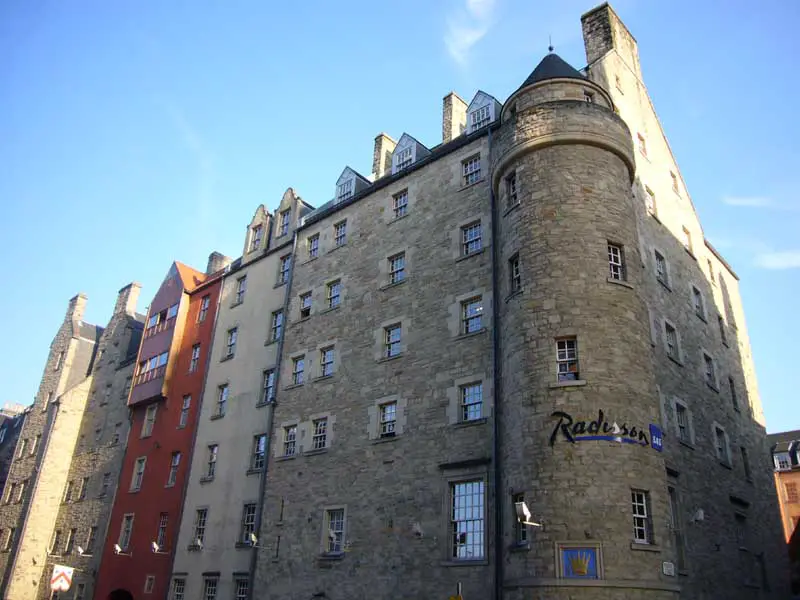
One of the key Royal Mile buildings in my talk was the Scandic Crown (renamed 2004 as Radisson Hotel Edinburgh) completed in 1990. A sound bite from the Cockburn Association in the 1970’s stated that ‘the large hole between Blackfriars and Niddry Street once so satisfactorily occupied by early eighteenth century tenements, is one of the most important underdeveloped urban sites in Europe’.
After a few failed attempts Barratt’s employed Ian Begg to design the scheme for this Royal Mile site. In his writings he describes it as traditional with tall tenements and back courts with houses on the upper floors and workshops to the rear. With Strichen’s, Cant’s and Dickson’s Close being substantially reinstated. Indeed at this stage the Cockburn was full of praise stating that they ‘commend the way in which the proposed development would use the site and would respect the historic plan form of the Old Town’. Praise from the Cockburn Association is not easily achieved.
The problems seem to have arisen when this Royal Mile site was sold to the Danish firm, Dancon. Their proposals were for a 250-bed hotel with the residential component being restricted to 25% of the site. Previously the scheme had been designed as separate blocks. Now levels had to be changed and the hotel crashed through these dividing walls.
The workshops from the previous scheme were lost as were the majority of the ground floor units. The biggest loss, however, is the closes that would have run through the building. We are left with a huge impenetrable block within the Old Town. The names of the closes still remain but these simply serve as fire escapes to the hotel’s facilities.
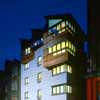
Old Town Housing: Royal Mile frontage, image © Adrian Welch
Another important project to examine on the Royal Mile was ’s Old Town Housing Association project on the Canongate. Adrian describes this building on this site as ‘The frontage has a quirky Old Town feel; it doesn’t shout but it also isn’t overly polite’.
The building is one of the best examples of new build on the Royal Mile over the twenty years I was examining. Therefore I spent a long time questioning whether this building was actually polite to its Canongate location. I was sure Richard did not mean it to be polite, but in the end could not make up my mind so left it to the audience to answer.
I then jumped from a quality building to a poor building. The important thing to notice is that the client is the same in both instances. Wilson Court Housing off the Royal Mile was built for the Old Town Housing Association in 1997. Why did Campbell & Arnott get it so right on the Holyrood North site and so wrong on the Canongate? To me it looks like it has been squashed at the front with a very horizontal emphasis. If you walk through the site you will notice how the materials have already started to look cheap.
Maybe the Old Town Housing Association turned a corner with Richard and realised the importance of good design. They appeared to have continued along the right path with their adjacent scheme by E&F McLachlan completed in 2000.
I was in danger then of slipping off the Royal Mile into Holyrood North but there has been an immense amount of activity by architects mainly for the Housing Associations and Moray House. Views of the buildings can also be seen from the Canongate and the Masterplan has been an extremely successful scheme. The standard of architecture in some of the buildings can be hidden by the high quality of the urban design. Hope’s Masterplan controls building plots, heights and provides penetration into the site. Edinburgh must learn the lessons form this masterplan and use this approach more often.

The Hub, Royal Mile: image from Ben Tindall Architects
The Hub for me is a building that I must enthuse about. This building oozes charisma and has provided a fantastic home to the Edinburgh Festival. Empty for over a decade, the National Lottery has brought a massive boost to Edinburgh no more so than at the Hub. For me the Lottery is most successful when it matches up a long term user to an empty historic building.
Some may think that Ben went a bit over the top with the colour scheme. For me it makes me smile and that is all I require. Again I would refer to Adrian’s web site as he appears to pay Ben a massive compliment when he states that ‘the project does take risks and challenges the status quo with its vivid contrasts of colour and approach to conservation’.
The Hub provides us with hope that we can revitalise all our historic buildings on the Royal Mile. The key appears to be matching a long-term occupier with a building.
Of most importance to the Royal Mile during the last twenty years was the work undertaken by Page and Park. Their designs for the public realm have changed the fortunes of the street. The concept of giving more space to the pedestrians is one that has to be rolled out across the city. Just think how Princes Street could benefit from such an enlightened approach.
The teething problems should not be allowed to diminish the success of the scheme. It is my belief that this success lies in the fact that you don’t really notice it. It just blends into the street and complements rather than competes with the buildings. Nothing fancy that shouts at you just high quality materials.
I am slightly concerned at present about its flexibility. The introduction of a bus gate on the High Street has forced the introduction of new elements and the relocation of the bus stop. This has been done in a cheap and tawdry fashion and as usual a huge investment is being slowly eroded by the City Council.
Before I heap too much praise on we must address the issue of Hunter Square, set off the Royal Mile near the Bridges. I have not got to the bottom of the reasons behind this failure in design. High Quality Materials, public art, benches etc seems a recipe for success. But it is a muddle, a mess and has proved a popular venue for drunks. Is it Jan Gehl who stated that Nothing Happens were Nothing Happens. It certainly applies here apart from during the festival when it provides a popular venue.
The future of Hunter Square is entwined with the future of the Tron.
If we are to provide disabled access to this misused building then it will be from the rear. Again to tie this building with a discussion of the 80’s and 90’s is simple. Over the 1990’s the Old Town Renewal Trust had over a million visitors to this Information Centre. The withdrawal of funding from the landfill tax operator and the absence of the Edinburgh Tourist Board led to the demise of this service. One must hope that its future does not lie with rentals to tour guide operators on a one-year lease.
Another historic Royal Mile building of concern is Acheson House, which has lain empty for over ten years. A 16th Century building in a talk on the twentieth Century is stretching it slightly. Its use during the 1980’s is of interest. As the Scottish Crafts Centre, it provided a base for craftsmen to display their wares to the public.
Again a theme that has returned to our discussions. To provide a base for this use on the Royal Mile should be an ambition for the future. Asbestos, however rules this building out of the equation at present. Plans have been drawn up join Huntly House and Acheson House to form the Museum of Edinburgh. Reliance on Lottery Funding brings a great deal of doubt to this scheme and the building will continue to lie empty.
This shopfront may be recognised as the old home of the Edinburgh Old Town Renewal Trust, which was established in November 1991 to promote and co-ordinate the renewal of the Old Town. We cannot underestimate the involvement of the Trust. Confidence has been created by the partnership between the Community, the City Council and the Enterprise Company.
One of their favourite schemes has to be the shopfront improvement grants, which was undertaken in partnership with the Enterprise Company. This was taken forward under the banner ‘appealing shopfronts, good for business’. There was a basic recognition that the appearance of shops affects the character of an area. If this type of scheme were undertaken as part of the Princes Street Vision the result would be amazing.
The Old Town Closes Initiative involving LEEL, CEC and the Old Town Renewal Trust has also brought a massive change to the Royal Mile. I would focus on my favourite completed in 1999, Trunks Close and Hopes Court. Here Turnbull Jeffrey Partnership undertook ‘a contemporary and sensitive regeneration of the closes and courtyards around Sandeman House’.
Indeed the best bits of the Royal Mile can be found if you wander down the closes. Crichton Close leads us to the Scottish Poetry Library a building designed by Malcolm Fraser. Again I lean on Adrian for his analysis ‘a jewel of a building which sits vividly in the mind (everyone remembers the blue bricks), best seen from outside where it is cleverly articulated’.
I have made a number of comments through my talk about materials. For me this is one the critical issues that must be addressed. I am wary of the phrase ‘traditional palette of materials’ that can be found in Conservation Area Character Appraisals. Would Malcolm’s blue bricks be allowed under these rules? How can we restrict the use of reconstituted blocks of a poor quality, but support innovation such as the Poetry Library? It is reported that the great bricks in the McLachlan flats were difficult to get past planing even though they merge so well into their surroundings.
A more recent gem of a building may also fall under these guidelines. Hopefully you all visited Allan Murray’s Under 5’s Centre on Old Assembly Close on Doors Open Day. I thouroughly enjoyed a tour by the head of the centre who was extremely proud to show off her new building. For me this is a delightful building on a small site; the children had only moved in a month ago but had already transformed the space into their playcentre.
Royal Mile Edinburgh: The Future
I ran out of time and was unable to mention other schemes such as the refurbishment of St Giles with its new gold balls; the work on the Law Courts; the statue to David Hume; or even the shopfront to the Fringe Office. The Royal Mile has enjoyed a successful twenty years. Forget about Rethinking the Royal Mile let us simply complete the work that was started twenty years ago.
But I would be wrong not to point out the massive upheaval that is about to be undertaken. The movement of the Parliament down the Royal Mile will leave us with a large number of buildings whose future needs to be resolved. Old Midlothian Buildings may become the Registry Office. While the Lothian Regional Offices will probably face demolition or a major makeover.
The other problem is that the City Council will also be disposing of a number of buildings on and around the Royal Mile to raise funds for the new Edinburgh Council HQ on Market Street. Will we soon see more residential conversions from Buredi?
The use of the private car and the coach on the Royal Mile also needs to be resolved. I have already highlighted the problems of removing general traffic. But will we persuade the City Council to remove the parking from the City Chambers? Will Historic Scotland do the decent thing and close the Esplanade to coaches and cars?
So to conclude I have hopefully given you a taste of what has happened over the past twenty years on the Royal Mile. I believe that its future is prosperous and that we must continue the work that has been started and learn lessons from what has been achieved.
MARTIN HULSE Director of the Cockburn Association
Royal Mile: 1980s & 1990s Comment Dec 2002
Royal Mile Edinburgh Buildings
The Royal Mile is a historic street in Edinburgh Old Town, stretching from the Castle to the Palace.
Contents of this page: Royal Mile Architecture + Conference + History
Edinburgh Old Town Buildings – Scottish Capital Architecture Tour
selection at base of this page
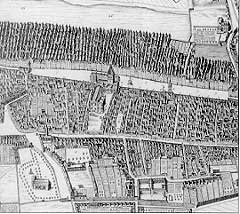
Royal Mile, Edinburgh: historic plan, usage approved by Charles McKean
John Knox House : middle of Royal Mile
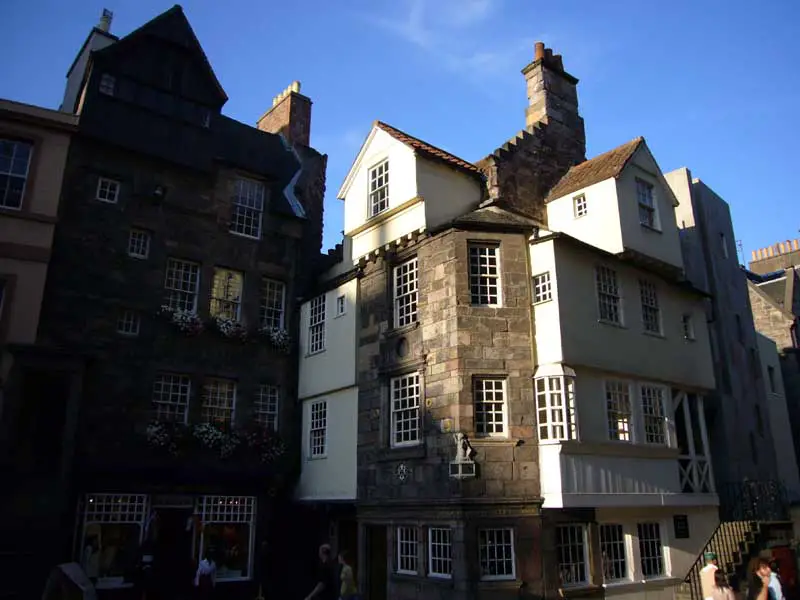
image © Adrian Welch
St Giles Cathedral: middle of Royal Mile
Edinburgh Castle: top of Royal Mile
Tron Kirk: middle of Royal Mile
Gladstone’s Land – Lawnmarket: top of Royal Mile
Radisson Hotel Edinburgh
building photo © Adrian Welch
Royal Mile building – Palace of Holyroodhouse
Buildings / photos for the Edinburgh Royal Mile Architecture pages welcome