| Wimpey Homes, Scotland, Shrub Place, Edinburgh, Photo, Developer, Architect Shrub Place : Public Enquiry, Edinburgh, Scotland edinburgh architecture |
Home Architecture News World Buildings |
||
| Shrub Place : Development Information + Images | |||
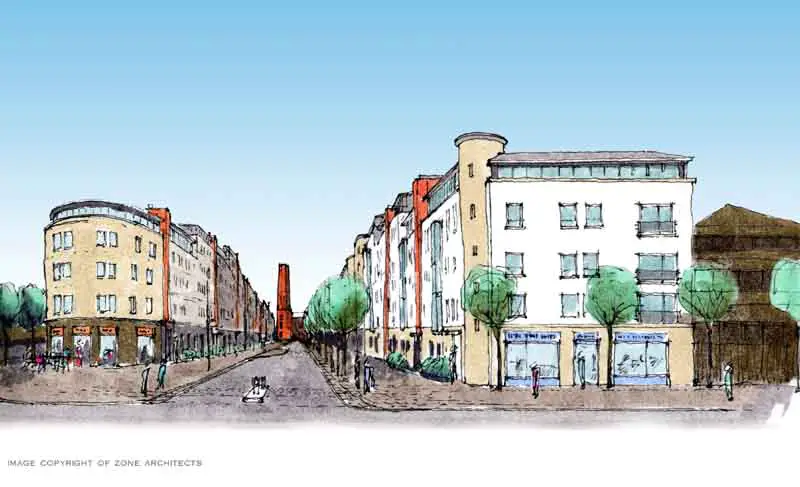
Shrub Place - Feb 2009 Update ![]() image © adrian welch Shrubhill House ready for demolition Shrub Place - Jan 2005 Update BL Developments win bid, out of ten offers for former LRT Bus Depot off Leith Walk. Lead architects with responsibility for master planning the site are Broadway Malyan out of their Edinburgh Office. Morgan McDonnell, Edinburgh, will have a significant role in the design of buildings on parts of the site. Shrub Place was placed on the market for a second time in Sep 2004. Bids were submitted by developers/architects on 30 Nov 2004 to LRT. Shrub Place, Leith Walk, Edinburgh: Public Enquiry This was a key architecture & planning issue / event for Edinburgh with well known architects presenting evidence and a very active 'Save Shrub Place' campaign website. Shrub Place PR 31 Aug 2004 Wimpey Homes Scotland concedes and walks away Wimpey, whose option to buy Shrub Place expired at the end of August, have decided to cut their losses and walk away from the deal. Having spent five years on the project, Wimpey did not come up with a design for the £30m site that satisfied local campaigners and failed - despite several attempts - to win approval from either the Planning Committee or the subsequent Public Inquiry. The Inquiry decision is widely regarded as a landmark case that will help improve design standards throughout the industry. Following Wimpey Homes' decision to abandon the site, the site owners, Lothian Buses, have appointed a new agent to market the property. Local campaigners were pleased that Wimpey Homes is finally out of the picture and are looking forward to a fresh, imaginative and appropriate design for this key site on Leith Walk. However, a spokesman added a more cautious note: "During half a decade, Wimpey has failed to manage this project properly and have been unable to come up with a design that is good enough. This has meant that a lot of time has been lost. A quality development on this site five years ago could have added to the quality of life in Pilrig and helped to relief housing demand. Instead, we had a lifeless, abandoned site with decaying buildings that brought new problems to the area." Because of the complexity of the site - which includes a listed building that formerly housed the transmission equipment for Edinburgh's cable tramway - campaigners are clear that any new proposals must address, and perhaps incorporate two neighbouring sites: the Council-owned Social Work Headquarters at Shrub Hill (due to be vacated in the near future) and the Masonic Social Club. Harald Tobermann, chairman of the Pilrig Residents Association, added: "Shrub Place is a landmark site on Leith Walk - halfway between the Castle and the Sea, between Edinburgh and Leith, between the Scottish Parliament and the Scottish Executive. Any new developer will need design skills of the highest order; and the ability to engage and negotiate meaningfully with the site's various neighbours and stakeholders." At the Public Inquiry in March 2004, the campaigners, represented by Mr Tobermann, chairman of the Pilrig Residents Association, presented a convincing case, showing that Wimpey Homes' proposals for Shrub Place had failed on design grounds, meeting neither local aspirations for a quality development on a city centre site nor the criteria of good design set out in the Scottish Executive's key policy document Designing Places. Wimpey acquired an option to buy the site in 1999. After a sustained campaign by local people, Wimpey's first design was about to be turned down by Council officials, but following behind-the-scenes pressures, was to many people's surprise recommended for approval.. Two planning committee rejections and more inadequate designs later, Wimpey Homes appealed to Scottish Ministers. Their appeals were turned down at the end of July 2004, following a 14-day Public Inquiry in March. Shrub Place - Building PR Jul 04 'Landmark case gives good urban design in Scotland a major boost' Shrub Place Inquiry Reporters dismiss Wimpey's appeal In a key decision, Inquiry Reporters dismissed Wimpey's appeals against earlier Edinburgh Council planning decisions. In their findings, the Inquiry Reporters largely accepted the arguments put forward by local campaigners during the two-week Shrub Place hearings in March. The Shrub Place campaigners, represented at the hearing by Mr Tobermann, chairman of the Pilrig Residents Association, had presented a convincing case, showing that Wimpey's proposals for Shrub Place had failed on design grounds. Deploying five witnesses, they demonstrated that Wimpey's proposals did not meet neither local aspirations for a quality development on a city centre site nor the criteria of good design set out in the Scottish Executive's key policy document Designing Places. The campaigners are pleased that the Reporters' decision has set a precedent for similar development proposals across Scotland and the UK and will force developers to raise their game. "We want to see a high quality development on Shrub Place and are delighted that this is now official policy", said Mr Tobermann. "This decision makes it clear that developers and their architects need to design for a conservation area of tomorrow, not just a scheme that makes money now, but is redundant and unattractive in a few years time." Looking to the future, he added: "We are keen to see fresh proposals for this landmark site as soon as possible and will be talking to Lothian Buses, who remain the owner of Shrub Place, and other interested parties at the earliest opportunity." Harald Tobermann, Pilrig Residents Association Witnesses for all parties:- Wimpey's witnesses Mr Paul Garber, Wimpey Mr Smith, Jenkins & Marr - architectural matters witness from Driver Jonas - daylighting Mr Pirie, Hurd Rolland - built heritage Mr Massie, Jenkins & Marr - planning matters Mr Boswell, WSP - transport Council witnesses Trevor Davies, Planning Committee Convener - planning and design Mr Murray, Allan Murray Architects - architectural matters Alice McGlone, City of Edinburgh Council - affordable housing Mr Gannon, City of Edinburgh Council - noise Mr Cameron, City of Edinburgh Council - design Pilrig Residents Association witnesses David Jamieson of Zone Architects - architecture and design Heather Wilson resident of Edinburgh's oldest colonies at Shaw's Place/Terrace and Street - Shaw's perspective Sarah Cumings, local resident and frequent pedestrian user of Leith Walk - pedestrian environmental perspective James MacLean, treasurer of Masonic Social Club - Masonic Social Club's perspective Harald Tobermann, Chairman and Urban Design Spokesman of Pilrig Residents Association - design statement and consultation Cockburn Association witnesses:- Oliver Chapman, Oliver Chapman Architects - architecture and design John Byrom, landscape architect - open space and landscape Recent Shrub Place press coverage: The Herald 22 Jul 2004 The Herald 9 Mar 2004 Evening News 9 Mar 2004 Evening News 8 Mar 2004 Shrub Place PR 22 Jul 2004 Shrub Place PR Mar 2004 An indicative sketch of an alternative Shrub Place scheme drawn up by David Jamieson (Zone Architects). ![]() David Jamieson's brief was restricted (by Shrub Place campaigner Mr Tobermann) to an illustration of a traditional legible street coming off Leith Walk, in contrast to Wimpey's inward-looking proposals and to demonstrate successful integration of the neighbouring site owned by the Masonic Social Club. Rather than spending effort on detailed architectural design, this was an urban design exercise which - for the sake of comparability - accepted Wimpey's assumptions about the site and its context (eg number of units needed and density achievable). Prompted by us, these assumptions were tested at two planning committee meetings (and found wanting) and the recent public inquiry. Wimpey (the developers) subsequently modified their proposal by replacing their original 2-storey pend to Leith Walk with a street opening, but still not achieving a successful layout within the site (compared to our simple proposal). They never discussed our alternative proposal with us. Mr Tobermann, Shrub Place Campaign leader: PR Mar 29 2004 Shrub Place Campaign PR Mar 04 The Shrub Place Public Inquiry concluded today, 25 March with closing submissions from Mr Tobermann on behalf of Third Parties, Mr Steele QC for Edinburgh Council and Mr Martin QC for Wimpey. Mr Tobermann's submission argued that the appellant, Wimpey, failed primarily on design grounds: while there clearly was a design, it was not good enough when measured against the six qualities of good design highlighted in the Scottish Executive's key policy document Designing Places: - Identity - Safe and pleasant spaces - Ease of movement - Sense of welcome - Adaptability - Good use of resources This was not a matter of subjective value judgement, but evidenced by the poor design statements submitted by the appellant. These amounted to a mere two pages without illustrations and failed to provide a design narrative (as outlined in government guidance PAN 68): a) how the six design qualities prescribed by Designing Places will be achieved b) how the appellant went about the design process c) why certain - possibly less attractive - design decisions were taken d) how certain design shortcomings of both appeal schemes could be fixed by post-hoc conditions without compromising the putative design integrity of either scheme. Describing the appellant's design as "unsound", Mr Tobermann concluded by asking the Reporters to dismiss all appeals and to make a number of constructive recommendations to guide subsequent fresh applications for Shrub Place. Mr Steele QC for City of Edinburgh Council relied in his submission on existing policies and guidance and demonstrated where the appellant had deviated without good reason. A key part of his submission covered poor day and sunlighting provision, as well as the large number of single aspect flats. He argued forcefully for the Council's Affordable Housing Policy to be applied, and cited legal precedent that an incorrectly described planning application (as in the case of the listed building consent sought with the second appeal scheme) must be refused by a Reporter. He concluded by inviting the Reporters to refuse the appeals before them. Mr Martin QC for Wimpey made a forceful case against the Council's handling of Wimpey's planning applications. His arguments for granting planning permission were far less convincing and suffered from too high a dose of vitriol. He concluded by asking the Reporters to award costs against the Council, whose behaviour he described as "unreasonable" to an unprecedented degree. Mr Steele QC, replying to the cost submission, refuted the accusations of unreasonable behaviour. He described some of the allegations, especially against him personally, as "breathtaking". The Reporters closed the Inquiry by thanking all participants. Their report and decision is not expected for some weeks or even months. Mr Tobermann, speaking after the Inquiry had closed, said: "While we regret that we were unable to refute the incorrect allegations against some of our witnesses made in Mr Martin's submission - the appellant has the last word - we remain quietly confident that our "design" case will stand up to the Reporters' scrutiny. Judging by the lacklustre arguments revolving around planning matters in Mr Martin's closing submission, compared to his case against the Council's alleged behaviour and his consequent claim for expenses which he presented with some gusto, Wimpey's case looks far less promising." Shrub Place Campaign PR Mar 25, 2004 Shrub Place is a landmark site on Leith Walk - halfway between the Castle and the Sea, between Edinburgh and Leith, between the Scottish Parliament and the Scottish Executive" Shrub Place Campaign PR Mar 23, 2004 The Shrub Place Public Inquiry concludes on 25 March with closing submissions, following two weeks of witness statements and intense cross-examination. The Inquiry will sit from 2.30pm at the McDonald Road Library's Nelson Hall to hear closing submissions from Mr Tobermann on behalf of Third Parties, Mr Steele QC for Edinburgh Council and Mr Martin QC for Wimpey. Harald Tobermann, chairman of Pilrig Residents Association, said: "We are grateful to all local residents and supporters who managed to attend the Inquiry whenever they could. Thursday's closing submissions - open to the public! - will neatly summarise the case made by all parties. We are quietly confident that ours and the Council's arguments are better and will win in the end." Key points that emerged during the Inquiry: a. Wimpey failed to provide a cross section of the crucial Leith Walk elevation of both their appeal schemes. Surveys conducted during the Inquiry established that the appearance of existing buildings on Croall Place was not accurately represented in Wimpey's drawings and that the falling ground of Leith Walk south to north with its attractive sandstone facades were insufficiently respected b. the future of the Masonic Social Club at Shrub Place Lane is under threat by Wimpey's proposals (including possible unreasonable constraints on residential development opportunities available to the Club) c. a key document, the Design Statement, meant to provide vital background and design reasoning, was produced by Wimpey only during the Inquiry and falls short of Government guidance in substance and volume d.. Wimpey is likely to concede that Edinburgh's oldest colonies, originally known as Pilrig Model Buildings, will keep their unique intimate character, but may still be threatened by overshadowing by Wimpey's proposed tall buildings south of the colonies e. fine vistas to Arthur's Seat and Calton Hill from the existing tower block (Inchkeith Court) will be disrupted by Wimpey's proposed second tower to the south of Inchkeith Court Shrub Place Campaign PR Mar 9 2004 The Shrub Place Public Inquiry got underway today at the McDonald Road Library's Nelson Hall. Following some technical/legal arguments between the Council's QC, Mr Steele and Wimpey Homes' QC, Mr Martin, it was Mr Paul Garber's (Wimpey's planning director) turn to step into the witness stand and present his evidence: Wimpey Homes had put in a lot of hard work, attended community planning workshops and pre-submission meetings with planning officials in good faith. They were surprised that councillors overruled planning officials' recommendation to approve Wimpey Homes' schemes repeatedly. During cross-examination (some five hours) by the Council's QC and me, Mr Garber agreed (had to) inter alia that: a. sunlight/daylighting problems had been identified by council officials (contrary to his earlier allegation that councillors had made up these reasons for refusal without the benefit of professional advice b. Wimpey Homes' experts on daylighting and heritage matters were hired only three months ago c. affordable housing was not something Wimpey Homes was willing to consider anywhere on the site, although they supported the citywide policy in principle d. Wimpey Homes instructed Jenkins & Marr (their Aberdeen based architects) to achieve a certain minimum number of units or floorspace AFTER they had made an offer for the site, but were not prepared to reveal actual figures e. Wimpey Homes seemed to have failed to provide a Design Statement for their latest scheme, contrary to a number of concrete requests f. both Wimpey Homes schemes would constrain the future potential residential development opportunities available to the Masonic Social Club g. Wimpey Homes did not provide a new noise report for their latest scheme, although it is allegedly quite different from their previous schemes h. there may have been a misunderstanding by Council officials, Wimpey Homes and Wimpey Homes' architects as to the difference between the Design Statement (to be written by Wimpey Homes accompanying the application) and the site design guidance document (written by the Council). The programme for the rest of the Inquiry is as follows (small changes are possible): 10 Mar: Wimpey's witnesses Mr Paul Garber, Wimpey (continued) Mr Smith, Jenkins & Marr - architectural matters witness from Driver Jonas - daylighting 11 Mar Mr Pirie, Hurd Rolland - built heritage Mr Massie, Jenkins & Marr - planning matters Mr Boswell, WSP - transport 12 Mar: Council witnesses Trevor Davies, Planning Committee Convener - planning and design Mr Murray, Allan Murray Architects - architectural matters 15 Mar witness from City of Edinburgh Council - affordable housing Mr Gannon, City of Edinburgh Council - noise Mr Timperley, City of Edinburgh Council - traffic 16 Mar Mr Cameron, City of Edinburgh Council - design witness from City of Edinburgh Council - education 17 Mar: Pilrig Residents Association witnesses David Jamieson of Zone Architects - architecture and design Heather Wilson resident of Edinburgh's oldest colonies at Shaw's Place/Terrace and Street - Shaw's perspective Sarah Cumings, local resident and frequent pedestrian user of Leith Walk - pedestrian environmental perspective James MacLean, treasurer of Masonic Social Club - Masonic club's perspective Harald Tobermann, Chairman and Urban Design Spokesman of Pilrig Residents Association - design statement and consultation Cockburn Association witnesses Oliver Chapman, Oliver Chapman Architects - architecture and design John Byrom, landscape architect - open space and landscape 18 Mar: Reporters' accompanied site visit 19 Mar: summing up Cockburn Association Pilrig Residents Association City of Edinburgh Council Wimpey Homes Scotland Unless otherwise indicated, the Shrub Place Inquiry will sit every day 9.30am to 4.30/5pm with a one hour lunchbreak. Show your support and attend the Inquiry when you can - just drop in. Recent Shrub Place developments and some background to the case is covered in articles by The Herald 9 March 2004 and the Evening News 9 March 2004. Shrub Place Campaign letter Dear Adrian The planning department's report before the Committee on Wednesday contains at least one serious logical flaw (see below for details) and both Wimpey's scheme and the Planning Report fly in the face of Scottish Executive guidance (see extracts from DESIGNING PLACES below). I think the points made below speak for themselves. Best wishes Harald Tobermann Pilrig Residents Association 17 Pilrig S, EDINBURGH Tel+Fax 0131 555 5956 Email Harald.Tobermann@PilrigRA.cjb.net Shrub Place Campaign PR Planning Department's Report on Shrub Place contains major flaws "in the approved Proposed Alteration to the local plan (March 2001), the entire site is redesignated Housing and Compatible Uses" (p12/p50 Policy) "the principle of residential use is therefore not opposed on the site" (p14/p52 Assessment) the report fails to mention that this proposed (but not yet adopted!) redesignation has been formally objected to. At the Public Enquiry earlier this year, the Reporter indicated that he is minded to approve the proposed change of use for the site BUT on the understanding that other relevant guidance (eg Scottish Executive's DESIGNING PLACES) would be fully applicable. The reporter's written findings have not yet been made public. The report fails to demonstrate how the application complies with DESIGNING PLACES. "since the adopted policy [of Affordable Housing] was not in place at the point of registration [of the application], it has already been agreed that the Affordable Housing Policy will not be applied" (p14/p52 Assessment) the change of use mentioned above and the Affordable Housing Policy are both part of the Proposed Alteration to the local plan, which has not been adopted yet. The report embraces the former, but rejects the latter. This is more than an inconsistency. This is a serious error and should on its own suffice to refuse the application in its current form. "the proposed density and layout detailed in the application drawings is NOT CONSIDERED SATISFACTORY" (p8/p46 Environmental and Consumer Services comment on application) the report addresses this unambiguous statement by delegating powers to the head of planning to approve any noise abating measures submitted subsequently by the applicant. Would any tinkering with such measures really overcome fundamental concerns about layout and density? Report and Wimpey Homes' Proposal are in conflict with key statements in DESIGNING PLACES: The following quotes are taken from DESIGNING PLACES and are clearly not addressed by the Planning Department's Report or the applicant's design. In addition to the minister (see below), advise from within the department (Design & Conservation - Policy & Projects, the section working on the Council's own URBAN DESIGN GUIDELINES) as well as from the Reporter on the Local Plan Enquiry have both verbally asserted the relevance of DESIGNING PLACES to Shrub Place and the current proposal. "Designing Places is now a material consideration in decisions on all planning matters" (Lewis Macdonald, Deputy Minister for Transport and Planning). "Saying that the council is committed to good design, or that development should respect its context, is not enough. Many local authorities have said just that for years, without significant results." "Development plans should contain a positive and sustainable vision of the area's future priorities based on a thorough understanding of how the area functions, the challenges it is expected to face and community requirements." The plan should set out key design policies relating to issues that are particularly important locally, and to specify areas and sites where change is expected." "Those six qualities - identity, safe and pleasant spaces, ease of movement, a sense of welcome, adaptability and good use of resources - are at the heart of good design for urban and rural development. Shrub Place Campaign circular 12 Aug 2004 Dear all a quick reminder to all with an interest in the campaign against Wimpey's plans for Shrub Place. As you know, Wimpey Homes' application will be decided 14 August by the Council's Development Quality Subcommittee. However, as Shrub Place is only item 8 on the agenda, discussion of the scheme's merits (if any) will commence from c. 10.30am onwards. It will be straightforward to slip in and out of the meeting room at any time. A good turnout is important to support those councillors on the Committee courageous* enough to speak out and vote against Wimpey's inferior proposal for Leith Walk's and Pilrig's most important site. Let's see whether our elected representatives will tear into and finally throw out Wimpey Homes' "large urban fabric with penetrations" (description of Shrub Place design by Wimpey's architect). Harald Tobermann Pilrig Residents Association * because the Planning Department has recommended the scheme for approval, Councillors will have to defend their decision without any assistance from planning officials, when Wimpey appeals to the Scottish Executive, thus risking ending up on the losing side, something politicians (and, indeed most other lifeforms) are reluctant to do. Scottish Architecture Hotel Missoni Edinburgh Walking Tours LRT Bus Depot, Leith Walk Wimpey Homes' six-storey 314-flat scheme for Shrub Place, Jenkins & Marr Architects, set to get go ahead next week. The proposed transformation of a derelict bus depot into luxury flats looks set to get the go-ahead despite a flood of protests from neighbours. Alan Henderson describes the plans as a good representative of contemporary design. 09.08.02 Scottish Housing Shrub Place was placed on the market for a second time, in Sep 2004. Edinburgh : back to index Comments / photos for the Shrub Place Architecture page welcome: info@edinburgharchitecture.co.uk Shrub Place Edinburgh : page - adrian welch / isabelle lomholt |
|
||